
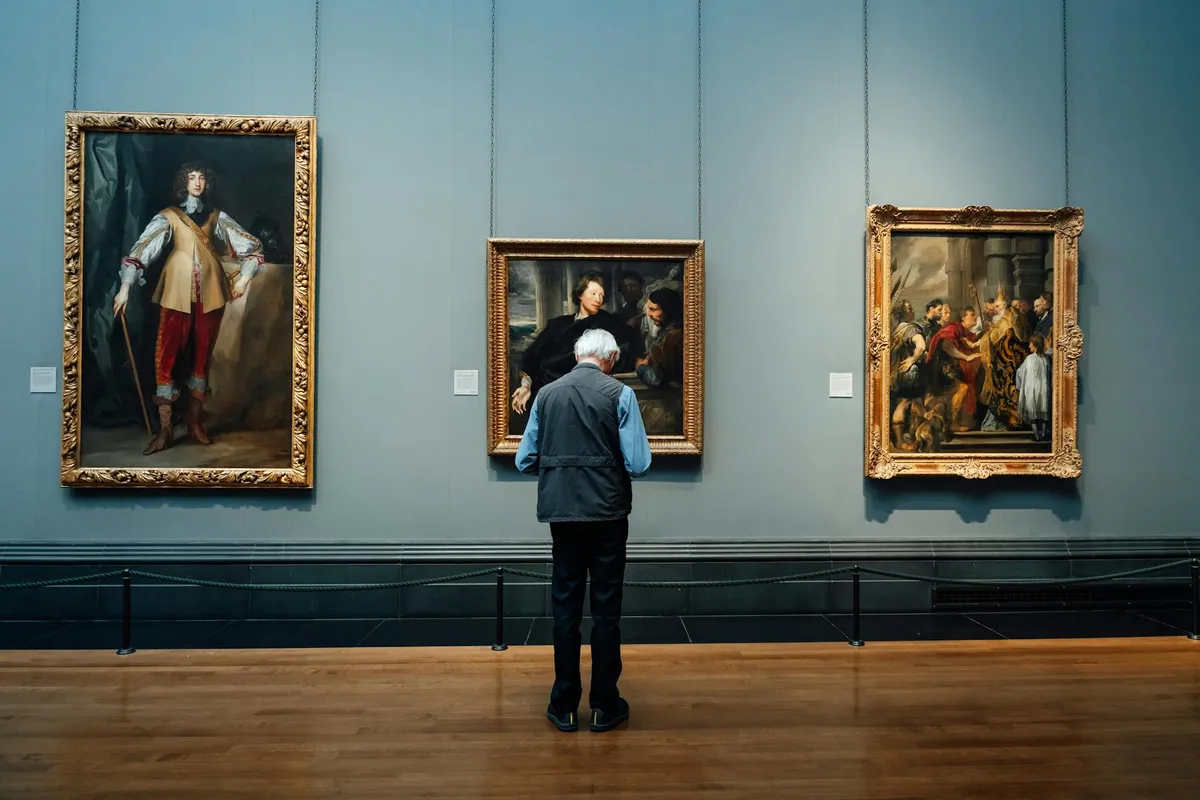
Walking through a major museum, one can perceive most paintings adequately in twenty seconds. Read the wall label, register the composition, notice the dominant features, move on. This is essentially the museum behavior pattern of most contemporary visitors.
Some paintings deserve this treatment. They are essentially shallow images that present themselves fully on first viewing.
Other paintings do not. They require years of returning attention to gradually reveal what they offer. These paintings tend to be the ones that endure across centuries of changing taste. The shallow paintings cycle in and out of fashion. The deep paintings remain.
I want to think through what makes the difference, and why it matters.
What shallow paintings do
A shallow painting accomplishes a specific visual effect that is fully apparent on first viewing. The composition is striking. The colors are arresting. The subject is recognizable. The technical execution is competent or even virtuosic. The viewer perceives the painting and understands it.
Shallow paintings can be excellent within their own terms. Many great commercial illustrators produce shallow paintings of high quality. Many contemporary painters work effectively in this register. The category is not pejorative; it describes a particular relationship between painting and viewer.
What characterizes shallow paintings is that they do not reward returning. After the first viewing, additional viewings produce minimal additional perception. The painting has already given everything it has to give. Looking at it twice is not substantially more rewarding than looking at it once.
What deep paintings do
A deep painting accomplishes effects that are not fully apparent on first viewing. The composition has subtleties that emerge only with sustained attention. The colors interact in ways that take time to register. The subject contains complications beyond its surface presentation. The technical execution rewards close examination.
Deep paintings reward returning. The second viewing reveals things the first missed. The fifth viewing reveals things the second missed. The fiftieth viewing reveals things the fifth missed. The relationship between painting and viewer continues to develop over time.
This is not a function of the painting being more difficult or obscure. Some deep paintings are immediately accessible at the surface level. The depth lies in what continues to emerge on continued examination.
Some examples
To be specific: Vermeer's "View of Delft" is a deep painting. The composition is immediately accessible — a city seen from across the water, with morning light. But continued examination reveals the extraordinary specificity of the light on individual buildings, the way the sky and water interact, the small figures in the foreground that situate the scale, the technical achievement of representing a particular weather condition with such precision. Marcel Proust thought it was the best painting in the world. He was probably wrong about "best" but right about the depth.
Rothko's "Number 14" is a deep painting in a different way. The composition is even simpler than Vermeer's — two rectangles of color on a field. Returning attention reveals what the simplicity is doing. The colors interact. The edges produce specific optical effects. The proportions feel deliberate in ways that take time to register. The painting does substantial work at scale that small reproductions cannot capture.
Velázquez's "Las Meninas" is a deep painting in yet another way. The composition is a riddle that has occupied art historians for centuries — who is looking at whom, what the mirror in the back shows, whose perspective the painting represents. The complexity is not just intellectual. The painting itself rewards looking in ways that the intellectual analysis explains but does not exhaust.
These three paintings are very different from each other. They share the property of rewarding sustained attention. Each gives more on the fifth viewing than on the first.
How depth is recognized
One of the practical questions for viewers is how to distinguish deep paintings from shallow ones. The distinction is not always obvious on first viewing.
Some markers that suggest depth:
The painting holds your attention beyond what the obvious features warrant. If you find yourself looking longer than the surface seems to require, something is engaging perception below the conscious level.
Different viewings produce different responses. If your perception of the painting changes over multiple viewings, the painting is interacting with you in ways the surface does not capture.
Reproductions do not satisfy. If the painting feels substantially diminished in reproduction (relative to the original), the painting is doing work at scale that small images cannot capture.
Other viewers report different perceptions. If knowledgeable viewers find substantially different things in the same painting, the painting contains more than any single viewing perceives.
The painting persists in memory. Shallow paintings often fade from memory quickly. Deep paintings remain available to mental review for years.
None of these markers is decisive. Together they provide reasonable signals.
The historical pattern
Across centuries, the paintings that have endured tend to be deep paintings. Shallow paintings cycle in and out of fashion based on changing taste. Deep paintings remain interesting to successive generations because they continue to reward attention regardless of what is currently fashionable.
This is not because deep painters were trying to make paintings that would endure. They were typically responding to immediate concerns of their time. But paintings that reward sustained attention tend to retain that property even as the original concerns of their making become historical rather than contemporary.
The Vermeers that depict 17th-century Dutch scenes are still interesting to 21st-century viewers because the paintings reward attention regardless of historical context. The Vermeers continue to develop relationships with new viewers across centuries.
What this teaches about practice
For practitioners of painting, the depth question matters substantially. A painter can decide, in effect, what relationship with viewers the work will support. Paintings made for immediate impact succeed differently than paintings made for sustained attention.
Both choices are legitimate. The question is which the practitioner is actually pursuing.
Most contemporary painting that succeeds commercially or critically operates in the immediate-impact register. The art market favors paintings that are quickly comprehensible in photographs. Galleries favor paintings that produce striking exhibition photographs. The economic structure of contemporary art tends to reward shallow over deep.
Painters who pursue depth despite this market pressure are pursuing a different relationship with their work and with viewers. The market for their work is smaller. The cultural function of their work is potentially more durable.
What this teaches about viewing
For viewers, the depth question affects how to approach museums, galleries, and personal collections.
If you have one hour in a major museum, you can either skim 100 paintings briefly or engage carefully with five. The latter approach produces substantially more perception than the former, despite covering less ground.
The carefully-engaged paintings are also the ones that you will remember a year later. The skimmed paintings will mostly fade from memory within days.
The choice is between coverage and depth. The contemporary museum experience usually defaults to coverage. The depth alternative is available to anyone willing to spend more time with fewer works.
A closing observation
The painters worth knowing well are mostly in the depth category. They reward years of returning attention. They do not give themselves up on first viewing.
This is good news for anyone who wants to develop their relationship to painting over time. The good paintings will not be exhausted by sustained attention. They will continue to develop their relationship with you.
It is bad news for anyone who wants to "do" painting quickly. There is no efficient path to deep engagement with deep paintings. The relationship requires what relationships require: time, attention, returning.
The paintings are patient. They wait for viewers willing to wait for them.